

by Brad Sanders (2026)
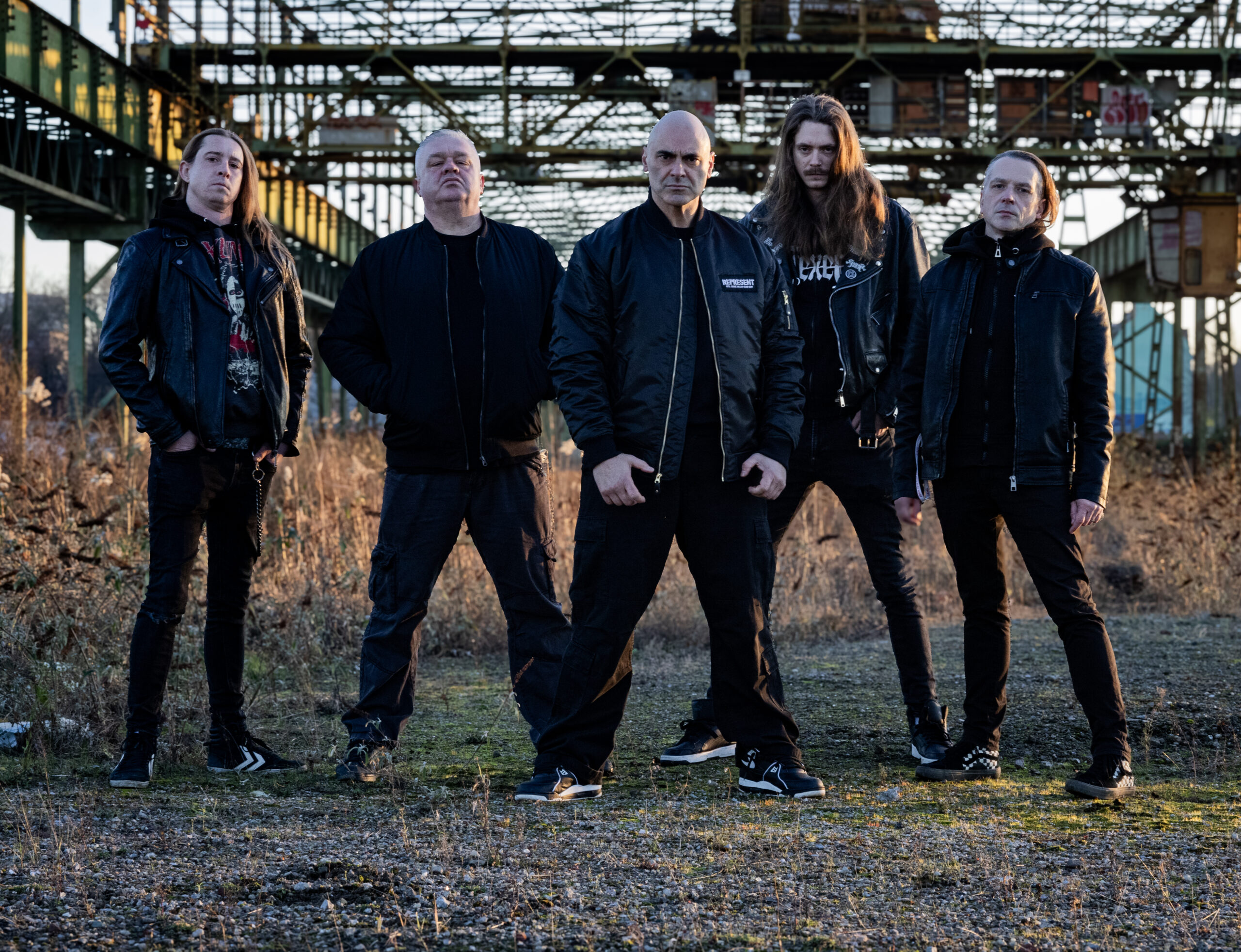
During their initial run in the 1980s, Exumer were one of the most important bands in Germany’s burgeoning thrash underground, but their ongoing presence in the 2020s has nothing to do with recapturing the glories of their youth. On Death Mask Messiah, Exumer’s sixth album, they sound as fierce, as hungry, and as creatively vital as ever. That’s entirely by design. When the band reformed in 2008, after nearly two decades of silence (save a 2001 appearance at Wacken Open Air), the agreement was that they would not traffic in cheap nostalgia. If Exumer was going to be a band again, they would be an active band—one rededicated to the craft of thrash metal, with eyes fixed only on the future.
“The vision was, we’re gonna do a real reunion, with full-fledged records on a real record label, and no throwback sound,” says vocalist Mem V. Stein. “We’d have the spirit of the ’80s, but without sounding like the ’80s. Going on tours, putting out records, the whole nine yards. No bullshit, just full steam ahead. That was the plan, and that’s what we did.”
The Exumer flame was first sparked in Frankfurt in 1985, in the crucible of a nascent Teutonic thrash movement. Stein and guitarist Ray Mensh had met briefly in 1983 on the train to the Monsters of Rock festival in Kaiserslautern, but it wasn’t until they reconnected at the Frankfurt stop of Slayer’s Hell Awaits tour two summers later that the idea of forming a band together came up. Both were 18 years old, metal-obsessed, and working the Slayer gig as a part of the local road crew. (These kinds of thrash-related odd jobs were not uncommon for the duo; on Metallica’s first German tour, Stein and Mensh picked the band up at the airport and bought them pizza.) After hitting it off at that Slayer show, Stein asked Mensh if he’d want to come jam at his dad’s junkyard, and the first iteration of Exumer was born.
The world that greeted Exumer’s first demo, 1985’s A Mortal in Black, and their now-classic debut album, 1986’s Possessed by Fire, was a world firmly in the grips of the thrash explosion. Out in California, Metallica, Slayer, and Exodus were pushing limits of speed and heaviness that just a few years prior would have been unthinkable. Back in Germany, Stein, Mensh, and their early Exumer bandmates Paul Arakaki, Bernie Siedler, and Syke Bornetto were tapped into the tape-trading community and the live metal scene, gobbling up all the inspiration they could.
“The whole vibe was of full-on movement, a metal revolution,” Stein recalls. “As cliche and cheesy as it sounds now, we all knew that we were part of something special, because we lived it. And we completely carved out our own little piece of territory in that space. We were definitely riding a vibe that felt completely organic, completely natural. I remember picking up Hell Awaits and thinking to myself, ‘Yeah, this is what I’m gonna do.’ There was no turning back.”
Exumer started just as thrash’s first German wave was burbling up out of the underground. They would join a loose federation of young bands from across Germany that were pushing even further past the old boundaries that Slayer and Metallica had worked so hard to obliterate. “It hit a nerve in Germany, and people were kind of morphing that style into a little cruder and rawer version of it, with a German touch,” Stein says. “If you think about it, really, there are two centers in the universe for thrash at that time, and that’s the United States and Germany.”
Kreator, Sodom, Destruction, Tankard, Deathrow, Assassin, Holy Moses, Mekong Delta, and more stood shoulder to shoulder with Exumer as Teutonic thrash became an established force in heavy metal. With its vicious performances, raw production, and a deceptively sophisticated ear for melody, Possessed by Fire remains one of the highlights of that period. Shortly after the 1986 sessions, though, Stein had a falling out with his bandmates and quit Exumer. (Two weeks later, they were all hanging out again, he says, but the damage was done.) Arakaki, who had played guitar for the band when they were still messing around at the junkyard, took over on vocals for 1987’s Rising from the Sea, but left when his family moved back to Hawaii. John Cadden took over for Arakaki and cut a demo in 1989, but the band dissolved before that lineup could make a proper recording. By 1991, Exumer was dead.
Stein, Mensh, and Siedler struck up a new collaboration in the ’90s with the Public Enemy-inspired rap-metal band Humungous Fungus. The two records they made with that project, 1994’s Low-Key Poetry and 1996’s Above Respect, sound surprisingly ahead of their time now, (“We dissolved that band in late 1998, and in early ’99 or so, Limp Bizkit is the biggest thing ever,” Stein laments.) Those albums might not have brought too many old-school Exumer fans to the party, but Humungous Fungus was nevertheless an outgrowth of Exumer ethics, through and through. Stein says that if he, Mensh, and Siedler had decided to play Possessed by Fire-style thrash in the ’90s, it would have been “fake, in the sense that we were feeling something else.”
“Just as that vibe was going on with thrash in 1985, when we started Humungous Fungus in 1993, I was hard into Wu-Tang Clan, hard into Cypress Hill,” he continues. “Rage Against the Machine was just popping off. There was a whole other wave that was coming, and we’re a part of that. It is still a real expression of who we were, just a different kind. It was real, and I will never deny that that was what I was feeling, or what we were feeling as a collective. It’s part of our history.”
That insistence on realness was what ultimately brought Exumer back to life in 2008, 17 years after the first era of the band ended. By that point, Stein had immigrated to the U.S. full-time, and he was running in metal circles again for the first time in years, even starting a new thrash band called Sun Descends to scratch an itch he was surprised to find returning. Meanwhile, his friendship with Mensh and Arakari had never wavered, so when everyone’s schedules finally seemed to be open enough to allow it, Stein approached them about reforming Exumer. (“Let’s give this band another chance, because it’s our band,” Stein recalls saying.) With liquid metal flowing through their veins once again, Exumer returned to the stage, a place they haven’t left in the nearly two decades since.
Arakaki left the Exumer fold after one reunion tour, but a series of lineups centered on Stein and Mensh released three albums on Metal Blade during the 2010s—Fire & Damnation in 2012, The Raging Tides in 2016, and Hostile Defiance in 2019. On those records, the band rose to their self-issued challenge of making music that carried the spirit of the Possessed by Fire era but had the musicianship, taste, and sensibility of a band of middle-aged guys working in the modern era. It’s a method that’s served them well; those albums aren’t limp throwbacks but artistically mature thrash albums, alive with the passion that went into their creation. Exumer’s current live show is built the same way. They’ll play a few cuts from Possessed by Fire, sure, but they’re just as proud of their newer material, and they present it all on equal footing. Don’t expect them to hit the full-album playthrough nostalgia circuit anytime soon.
“I don’t want to be that artist,” Stein says. “I’m not interested. I don’t put on bullet belts, I don’t put on battle vests, I don’t put on shit. I go out there the way I feel I have to represent, and that’s the entire band. We go out there and represent Exumer as it’s supposed to be as of 2026, not 1986.”
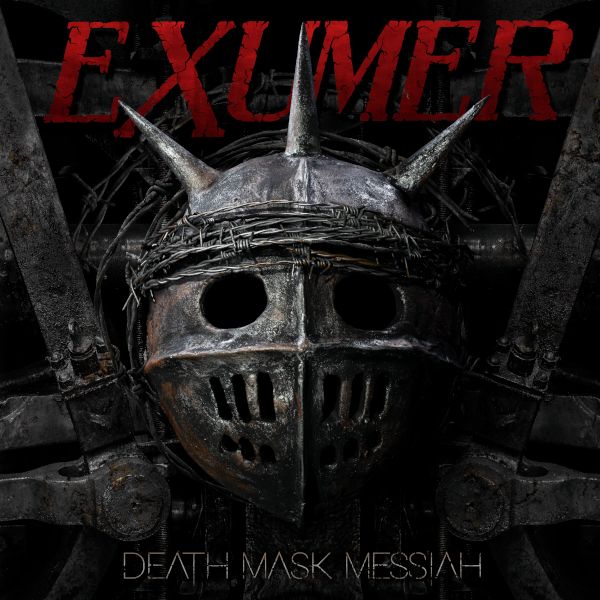
That brings us to Death Mask Messiah—the first Exumer album since 2019, and one the band is extremely proud to have under their (non-bulleted) belts. “It’s as true as we get,” beams Stein, and he isn’t kidding. Death Mask Messiah is a hard-hitting, dynamic record from a band that could only have made it by following their own code. The longer layoff between releases is atypical, and the COVID-19 pandemic certainly had something to do with that, but Stein says he never wants Exumer to be a band that makes an album every two years out of obligation.
“That’s why I love this band, because we don’t just put out records to put out records,” he says. “That’s not our way. Our way is, we put out records where every song counts. And if it takes six years, it takes six years.”
Death Mask Messiah would be worth any wait. Exumer are almost terrifyingly locked in, working through 42 minutes of muscular modern thrash with dead-eyed precision and an intensity that can’t be faked. The riffs are razor-sharp, the leads are molten, the drums are pummeling, and Stein’s vocal performance is a boiling cauldron of deliberately deployed rage, unleashed through a barrage of clipped syllables and strangled cries that still manages to be catchy. In fact, Death Mask Messiah is chock full of hooks, and without losing an ounce of the brutal heaviness that serves as its bedrock. The album also sounds remarkably organic, which Stein credits to Exumer’s hybridized but fundamentally old-school writing process.
“Those songs weren’t done with us sharing files,” he explains. “The foundation for each of those tracks is laid in the rehearsal space, and then all the fine-tuning is done online. Once the skeleton of a song is hashed out, then I’ll start coming up with lyrics, the idea, the concept around the record, and everything falls into place.”
The band also lays down their tracks the old-fashioned way, in a proper recording studio with a skilled producer on hand. For Death Mask Messiah, that producer was Dominic Paraskevopoulos, whom the band got to know through his acclaimed work with their countrymen in Kreator. (Arthur Rizk, another Kreator collaborator, handled the mix and master.) Exumer recorded with Paraskevopoulos at his Essen studio, Level 3 Entertainment, over the course of two months this past winter. “It was snowing, and it reminded me, actually, of when we recorded our very first demo,” Stein recalls. “It was also winter, it was also snowing, except we did it all in one night.”
Tracking went smoothly, even with two new band members to integrate. Bassist Alex Voss and drummer Jerome Reil both make their recorded Exumer debuts on Death Mask Messiah, and together they make for a formidable rhythm section that undergirds the riffs and solos being laid down by Mensh and co-guitarist Marc Bräutigam. Death Mask Messiah also marked a major first for Bräutigam, who wrote two songs (“Frozen Ground,” “Ravishing Waste”) for the album. Bräutigam joined the band in 2013 and has long made significant, critical contributions to the material, but these are his first Exumer songs as the primary composer. The sessions wrapped up in January 2026, and Rizk completed the mixing and mastering the following month. As soon as Rizk sent over the files, the band felt confident they had something special. “When everything is done, and you hear the end result, you feel proud, because this is real music, done by real people,” Stein says. “No AI bullshit, no file sharing. It’s still real stuff.”
Death Mask Messiah should hit with even more force for those who listen closely to Stein’s words. In a suite of loosely connected lyrical sketches, Stein draws astute parallels between the hellhole of contemporary American politics and the 1993 siege on the Branch Davidian compound in Waco, Texas that led to the deaths of 76 people, including 28 children. “David Koresh was a false prophet and wore a death mask, manipulating and leading his followers to certain death,” Stein says. “However, the misinformation that the federal government used in the ’90s is the same playbook that is being used today and is the common denominator between leadership in the past and present.”
The bloodsucking politicians and would-be saviors who populate Death Mask Messiah aren’t the only culprits. The mirror is turned back at us, too. Stein is concerned about the endless culture wars that pointlessly divide people, and he issues a plea for real solidarity, and for a rejection of the nihilism that can look so tempting in these inglorious times. This might seem naïve, but perhaps Death Mask Messiah can give back some of the meaning that this dark world seems bent on stamping out of people. Art matters. Music matters. Stein calls this new album a “second spring” for Exumer,” where “everything comes into bloom, and it’s a new beginning,” and that feeling of rebirth extends to the listener. By taking their craft as seriously as they do, Exumer represent a middle finger in the face of cynicism. If they can do it, so can you.